Pickleball's Gender Gap By the Numbers: How the Sport Compares
Every sport features a gender gap. The issue is not whether there is one, but rather the scope and locations of the disparity.
We analyzed pickleball players across the Tournament Pickle database to understand the gender gap in pickleball in terms of participation, skill level, elite player demographics, and geographic distributions of the sport. The TL;DR? Pickleball is relatively balanced between males and females compared to the majority of racket sports, but there are still areas of disparity and even discrepancies that grow wider.
Here's what the data says.
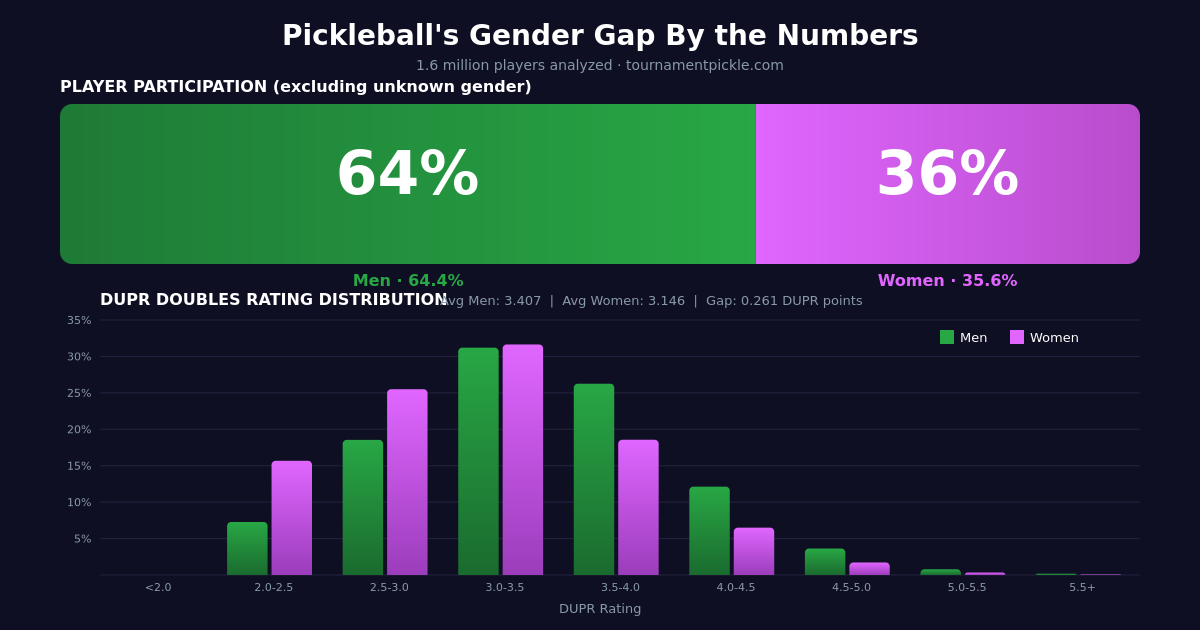
The Participation Gap: 64% Men, 36% Women
From the players in our dataset, about 55% are male and 30% are female, accounting for 15% with no specified gender on their profile.
Excluding the unknown profiles — as long as they are evenly distributed, which they likely are — pickleball is split 64.4% men / 35.6% women.
🏓 64/36 is good news. For comparison, golf is 77% male. Running events are around 60/40. Tennis is 65/35. Pickleball’s numbers put it among the most inclusive sports for women to compete in in America.
What reasons make pickleball relatively balanced? A few reasons why pickleball is relatively balanced include that it is less physically demanding than tennis (smaller court, underhand serve, lighter paddle), it has a strong social component that brings together players of all skill levels and backgrounds, and it exploded in popularity through community rec centers which tend to draw diverse populations.
Yet again, 64/36 is not 50/50. Nearly two men take the court for every woman. And as we'll discover, the ratio behaves differently when measured other ways.
The Rating Gap: Smaller Than You'd Think
The DUPR rating system provides the best overall measure of player skill regardless of gender. Among rated doubles players:
| Metric | Men | Women | Gap |
|---|---|---|---|
| Avg Doubles DUPR | 3.407 | 3.146 | 0.261 |
| Rated Players | ~553K | ~331K | — |
There is a real gap of 0.261 DUPR points but it’s quite small. Both men and women peak in the 3.0–3.5 range (solid intermediate level) and the peaks are strongly overlapping.
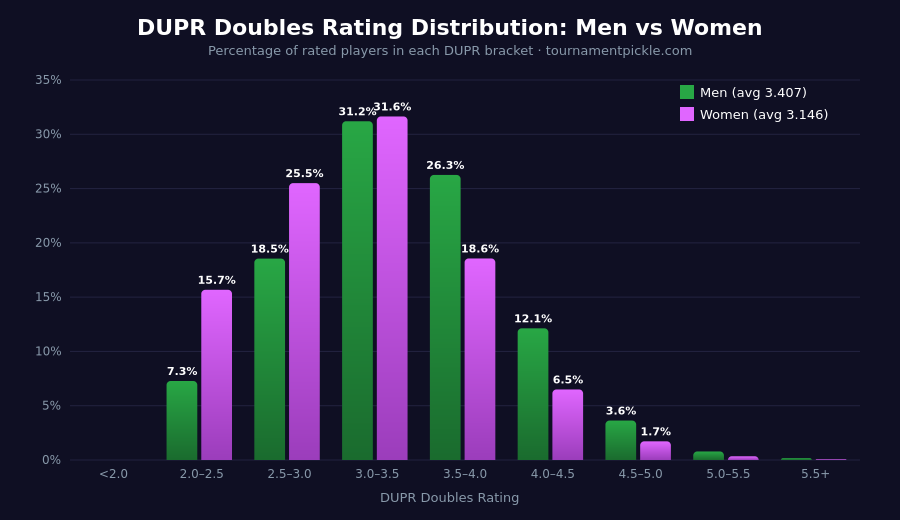
DUPR doubles rating distribution: men (green) vs women (purple), shown as % of each gender's rated players
The distribution chart shows what? Women are disproportionately concentrated in the 2.0–3.0 band (41.2% of women versus 25.8% of men), while men are more evenly distributed at higher levels. The peaks for both sexes occur at 3.0–3.5, though men have a longer rightward tail.
What does it look like in real life? In random pairings of men and women, men are slightly higher in overall rating – by about half a skill level. But in the mid-player (recreational) world where pickleball really happens, who cares?
The Elite Gap: Where It Widens
The small average gap hides a lot of unevenness at the high end of the rating scale. As you move upward in the DUPR ranks, the gender gap becomes successively wider:
| DUPR Level | Men | % of Rated Men | Women | % of Rated Women |
|---|---|---|---|---|
| 4.0+ (Advanced) | ~92K | 16.7% | ~29K | 8.6% |
| 5.0+ (Elite/Pro) | ~5,300 | 0.96% | ~1,300 | 0.40% |
Men are almost twice as likely to reach 4.0+ as women (16.7% vs 8.6%). They are 2.4:1 favored at 5.0+ (elite). The overall study found a participation gap of 1.8:1. However, the elite level showed a much greater disparity.
This is not pickleball-specific. Most sports exhibit a widening of the gender gap at higher levels of competition ( physiology, experience level, training/ competitive opportunities, tournament participation). Yet, it’s worth noting even at 4.0, there are nearly 29,000 advanced level female competitors. This represents a substantial amount of talent.
Looking at the ultra-elite at the top: there are around 5,300 men and 1,300 women rated 5.0+ across the country. Of those, the insane ultra-elite 5.5+ tier is under 1,000 men and around 200 women. These players are at or just below the professional level, and the pipeline for women is ultra-competitive.
For some perspective on where you stand in relation to others, you can check out our age group breakdown of DUPR ratings — that offers a more refined view of the performance data by age category.
Gender Balance by State: Minnesota Leads, Texas Trails
The gender gap in pickleball player numbers is not equal across the entire country. The percentage of women players in the twelve states with the most pickleball players ranges from 33.8% to 39.5%.
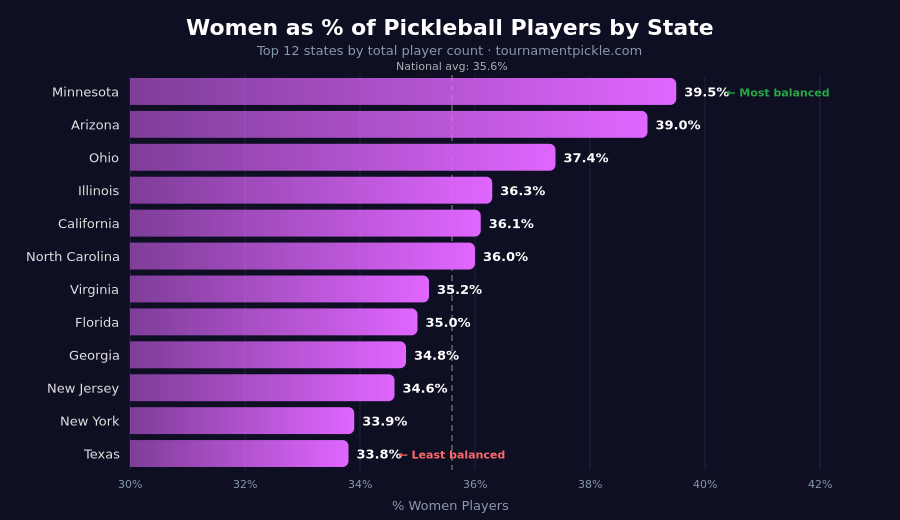
Women's participation rate as a percentage among pickleball players across the top twelve states by the number of players.
| State | % Women | Notes |
|---|---|---|
| Minnesota | 39.5% | Most balanced major state |
| Arizona | 39.0% | Strong retirement community presence |
| Ohio | 37.4% | |
| Illinois | 36.3% | |
| California | 36.1% | |
| North Carolina | 36.0% | |
| Virginia | 35.2% | |
| Florida | 35.0% | |
| Georgia | 34.8% | |
| New Jersey | 34.6% | |
| New York | 33.9% | |
| Texas | 33.8% | Least balanced major state |
A few observations:
- Minnesota leads at 39.5% women — 6.1 percentage points above Texas. The Midwest’s robust community recreation infrastructure and park-and-rec system probably contributes to this.
- Arizona at 39.0% is reasonable because it has a large population of retired individuals and pickleball is a popular social activity for men and women in these age groups.
- Texas and New York trail behind other major states. These high-population states with mixed demographics feature predominantly male player populations that skew slightly more male than average.
- The spread between the top and bottom is only 5.7 percentage points, which indicates that the gender gap is relatively uniform across the country with only minor variations from region to region.
How Pickleball Compares to Other Sports
Context makes a difference. Here’s the gender balance for pickleball compared to 8 other popular sports for recreational players:
| Sport | Approx. % Female | Source |
|---|---|---|
| Running/Road Races | ~40% | RunRepeat |
| Pickleball | ~36% | Tournament Pickle (this analysis) |
| Tennis | ~35% | TIA/USTA |
| Cycling | ~30% | USA Cycling |
| Golf | ~23% | National Golf Foundation |
Pickleball ranks with tennis and ahead of golf and tennis. This is impressive given that pickleball is a younger sport still in its growth phase. Most sports take decades for men and women to compete equally — pickleball is an exception.
What's Driving the Remaining Gap?
The 64/36 female-to-male birth ratio did not occur randomly due to the following causes:
1. The competitive pipeline
Men make up the majority of players in competitive/tournament scenes. Our data comes from players who have registered for events or have a DUPR rating (a skewed sample of the competitive scene). The bulk of recreational pickleball players (the millions playing at a recreational level out at parks and rec centers) is probably more evenly divided by gender than tournament players are.
2. Crossover from other racket sports
Pickleball players often come from tennis, racquetball or table tennis backgrounds — sports which have historically male-heavy participation. As the game starts to draw in first-time, novice racket sport players (here's our guide to your first tournament) (versus those with prior experience in other games), the gender skew may trend back towards equality.
3. The social vs. competitive divide
Women play recreationally more than men and are much less likely to participate in tournaments or obtain DUPR ratings. Thus, the actual participation gap will be closer to 64/36 than our number which picks up the least recreational players at the competitive level.
4. Growth trajectory
Pickleball is still one of the fastest-growing sports in America, and new sports often start out with a male-heavy participation base that later equalizes. The trend is more significant than the current state of affairs — and by all accounts, women’s participation is accelerating at a faster rate than men’s.
🔍 Look Up Any Player's Rating
Search DUPR ratings, tournament history and more for pickleball players across the country.
Search PlayersThe Bottom Line
Pickleball’s gender gap is real — but it’s much narrower than in most sports. The numbers don’t lie:
- Participation: 64% men, 36% women – beats golf (77/23) and ties with tennis (65/35)
- Average ability: There is only a 0.261 DUPR point difference between men and women, slightly less than half of a skill bracket.
- Pro and semi-pro scene: At the elite level, men are significantly more likely than women to hold top academic grades, with men being two times more likely to achieve a 4.0+ grade and 2.4 times more likely to achieve a 5.0+ grade.
- Geography: Minnesota (39.5% women) to Texas (33.8%) — a narrow 5.7-point difference across top states
The statistics reveal a sport that is leading in gender equality, yet still has work to do. The sport’s participation gap is narrowing, the skill gap is shockingly small at the recreational level, and 499,000 women are already on the court. At the elite level, the numbers are thinner, but with 28,900 women already rated 4.0+ and more joining the ranks, there is talent to spare.
For a sport with essentially no history 15 years ago, those are remarkable statistics. The trends are just as impressive as the statistics themselves. Pickleball's trends are definitely pointing upward.
Want to explore more? Check out our complete guide to DUPR ratings, see how ratings vary by age group, or explore which states are most obsessed with pickleball.
📋 Methodology
This analysis is based on players in the Tournament Pickle database as of February 2026. Gender data comes from player registrations and DUPR profiles. Players with unknown or unspecified gender (~15%) are excluded from ratio calculations. Only doubles ratings from DUPR are used for calculations. State-level data is limited to the 12 states with the highest total number of players. Comparisons to other sports are based on publicly available data on participation in other sports from relevant industry organizations, with caveats.