DUPR Rating Explained: What's a Good DUPR Rating in Pickleball?
If you play pickleball, you’ve probably heard people talking about their DUPR rating. It’s the language of pickleball talent that unites tournament players, recreational players, and pros of all levels.
What is DUPR and how does it function? The most significant question is what represents an excellent DUPR rating.
We looked at hundreds of thousands of players with DUPR doubles ratings to get these answers from the data. New to pickle? Want to climb out of the 3.0 grind? This guide has all the answers.
What is DUPR?
DUPR means Dynamic Universal Pickleball Rating. It is the most popular rating system in pickleball. DUPR calculates a unique rating for every pickleball player to determine their skill level objectively.
Unlike older self-rated systems where players would choose their own rating level (and often inflate themselves), or a coach would determine your level by watching you, DUPR calculates your rating based on matches. Every match you play, from a tournament title match to a casual rec match, counts towards your DUPR.
DUPR is the definitive pickleball rating system. Major organizations such as the Professional Pickleball Association (PPA), USA Pickleball and thousands of local pickleball clubs and tournaments use DUPR for everything from seeding brackets in tournaments to placing players in leagues and on the court with players of a similar level of skill.
Get your DUPR rating at dupr.com - free to sign up and start playing. With hundreds of thousands of rated doubles players already, DUPR is the best way to measure your pickleball progress.
How DUPR Ratings Work
The beauty of DUPR is that it's results-based, not opinion-based. Here's how the system works:
The Algorithm
DUPR employs a proprietary algorithm that calculates your rating based on your match scores and takes into account the following variables
- Game scores — not just wins and losses, but the actual point margin. Winning 11–2 tells a different story than winning 11–9.
- Opponent and partner ratings — beating a 4.5-rated opponent is more valuable than beating a 3.0-rated opponent. Winning with a lower-rated partner is also more valuable.
- Match type — DUPR accepts results from what types of play? — DUPR accepts results from tournaments, recreational leagues and organized leagues. Tournament results from sanctioned events carry more weight.
- Recency — more recent matches have a larger effect on your rating than older matches, so your DUPR reflects your rating for the present moment.
Separate Singles and Doubles Ratings
DUPR has separate ratings for singles and doubles because the two games are different. You might be a 4.2 in doubles but only a 3.8 in singles and who’s to say that’s not okay? Singles is by far the least common format so the focus of this analysis is on doubles ratings.
The Rating Scale
DUPR ratings range from 2.000 to 8.000 and are reported to three decimal places. The following are general skill levels:
| DUPR Range | Skill Level | Description |
|---|---|---|
| 2.0 – 2.5 | Beginner | New to the sport, learning fundamentals |
| 2.5 – 3.0 | Beginner+ | Consistent rallies, developing strategy |
| 3.0 – 3.5 | Intermediate | Good fundamentals, working on placement and game IQ |
| 3.5 – 4.0 | Advanced Intermediate | Strong all-around game, competitive in local leagues |
| 4.0 – 4.5 | Advanced | Excellent skills, competitive in regional tournaments |
| 4.5 – 5.0 | Expert | High-level tournament player, near-elite skills |
| 5.0 – 5.5 | Elite | Elite amateur or semi-pro level |
| 5.5+ | Professional | Tour-caliber player |
For context, the two best players in the world are Ben Johns with a 7.162 DUPR doubles rating and Anna Leigh Waters with a 6.857, making it just 190 players worldwide who are rated 6.0 or above in doubles.
What's a Good DUPR Rating?
This is the question every pickleball player wants to answer: "Is my DUPR rating good?"
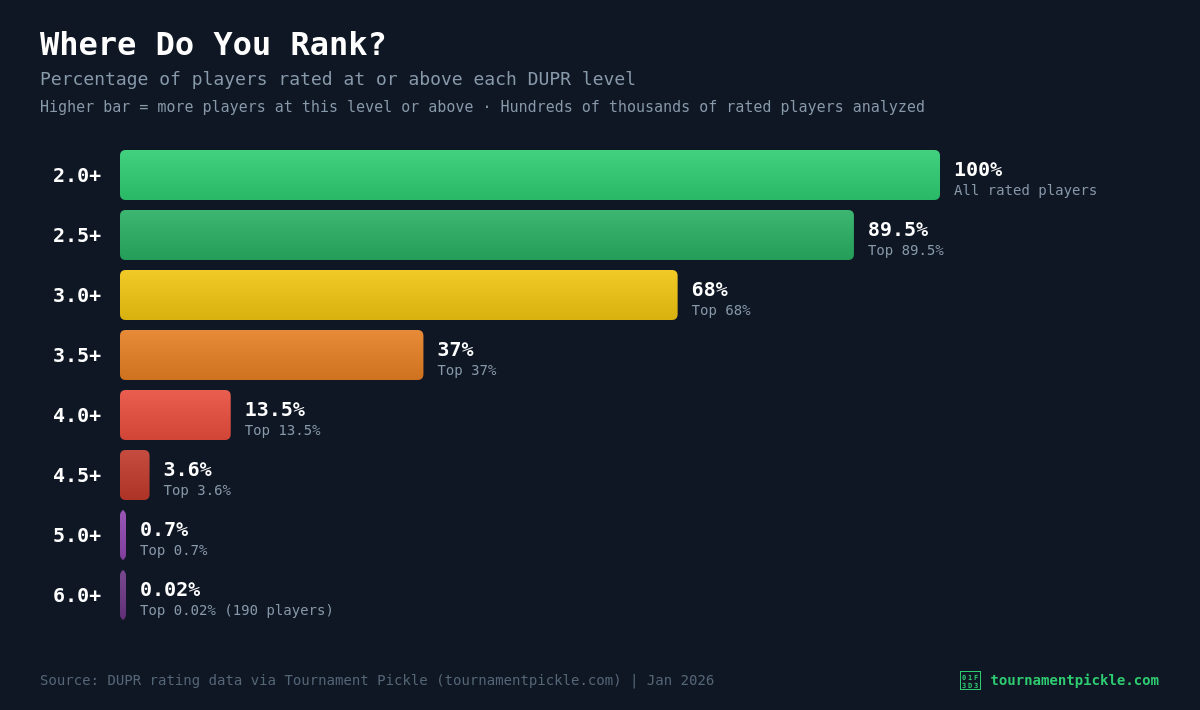
The answer depends on context, but we can offer you something better than wild guesses — actual percentile ranges for hundreds of thousands of players with DUPR doubles ratings.
Here's exactly where each rating level falls:
| DUPR Rating | Percentile | What It Means |
|---|---|---|
| 3.0+ | Top 68% | The majority of rated players are at this level or above |
| 3.5+ | Top 37% | Above average — you can hold your own in most rec play |
| 4.0+ | Top 13.5% | You're better than 86.5% of all rated players — definitively "good" |
| 4.5+ | Top 3.6% | Elite territory — fewer than 1 in 25 players reach this level |
| 5.0+ | Top 0.7% | Exceptional — fewer than 1 in 100 players reach this level |
| 6.0+ | Top 0.02% | World-class — just 190 players in the world |
🏆 Here’s the short version: If your DUPR doubles rating is 3.5 or higher, you outplay the majority of all rated pickleball players. If you’re 4.0 or higher, you’re in the top 13.5% and you should feel great!
What About "Average"?
The mean DUPR doubles rating is in the 2.5-3.5 range. The 3.0-3.5 range is the most common (31%), followed by 3.5-4.0 (23%) and 2.5-3.0 (21%). The ratings form a normal curve around 3.0-3.5.
This makes sense. Most players who commit to getting a DUPR rating are already past beginner level. The distribution increases steadily from 2.0–2.5 (10.5%) to 2.5–3.0 (21%) before peaking at 3.0–3.5 and then decreases as skill levels become more comparable.
DUPR Rating Distribution: The Full Picture
Let's look at how rated players are distributed across the DUPR scale:
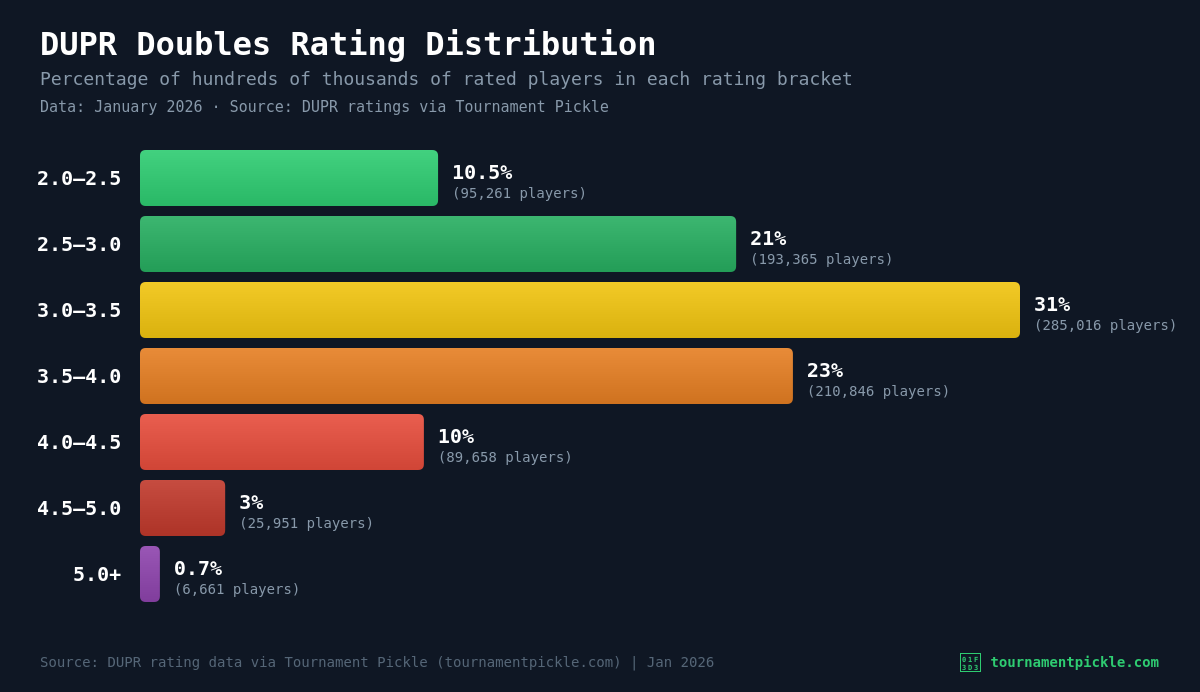
DUPR doubles rating distribution across hundreds of thousands of rated players (January 2026)
| Rating Range | % of Players |
|---|---|
| 2.0 – 2.5 | 10.5% |
| 2.5 – 3.0 | 21% |
| 3.0 – 3.5 | 31% |
| 3.5 – 4.0 | 23% |
| 4.0 – 4.5 | 10% |
| 4.5 – 5.0 | 3% |
| 5.0+ | 0.7% |
Key Takeaways from the Distribution
- The majority falls within the 3.0–3.5 bracket (31%) – this is the committed intermediate stage, players who have moved beyond the fundamentals and are actively working on their game.
- Only around 10% of rated players fall in the 2.0-2.5 range — the beginner bracket is quite small, suggesting that most players with DUPR ratings are beyond the beginner level.
- A sharp drop off above 4.0 — only 13.5% of players achieve a 4.0 rating. This is the level where recreational players have really "turned the corner" in their pickleball mastery.
- 5.0+ is in the 1% club — or more precisely, the 0.7% club. It's exceptionally rare.
- 6.0+ is almost legendary – only 190 players globally. These are the top players, touring pros playing on the PPA Tour and MLP circuits.
Percentage of players rated at or above each DUPR doubles level
How to Improve Your DUPR Rating
Here are practical methods which achieve those results:
1. Play Verified Matches
Your DUPR only updates on log events. The more matches you log – especially sanctioned tournaments and organized leagues – the more accurate and responsive your rating will be. Tournament results have the highest value in the algorithm.
2. Play Up (Strategically)
Playing against opponents rated higher than yourself provides bigger rating gains for a win. You don’t need to win all games. Competitive losses (close scores against high rated players) will also be seen as improvements by the algorithm.
3. Dominate When You Can
Remember, DUPR considers game scores, not just matches. Winning 11–3 beats winning 11–9, especially against softer opponents. You have to stay focused if you outplay your opponent.
4. Focus on Consistency
DUPR rewards players for consistent performance rather than one or two peak periods. You will see a greater increase in your rating for ongoing solid play than for the results of a single successful tournament followed by less consistent play.
5. Improve Your Actual Game
This sounds obvious but deserves to be stated: the best way to improve your DUPR is to improve your game! Take lessons, practice specific shots, and watch you play to identify the weaknesses that cost you points. Improve the following areas which generally bring the best return for effort:
- Third shot drops — the single most important shot in competitive doubles
- Kitchen (NVZ) play — dinking patterns, resets, and soft game
- Serve and return consistency — free points from unforced errors add up fast
- Court positioning — moving in unison with my partner for a doubles game while establishing dominance near the kitchen line.
- Shot selection — knowing when to speed up, when to reset, and when to be patient
6. Enter Tournaments
Tournament matches are the best data point for your DUPR rating. New to competing? Check out our first pickleball tournament guide. Tournament matches are verified, competitive, and have more weight in the algorithm than casual play. And the stakes of tournament play push you to improve. Find tournaments near you on Tournament Pickle to get ready to play your next match.
How to Sign Up for DUPR
Getting your DUPR rating is free and easy:
- Go to dupr.com/signup
- Create your account with your name and email
- Claim your profile — if you have played in any DUPR tournament your match history will already be there
- Start logging matches — record results from tournaments, leagues, and rec play
DUPR is 100% free to players. You can see your rating, track your progress, find other players around your level, and join clubs for zero cost.
📲 Tip: Download the DUPR app on iOS and Android to record your matches straight from the court. The quicker you do this, the sooner your ratings will be updated.
If you pickles year round, from once a week to daily, you need a DUPR rating. It’s the pickleball rating system, and it will get you into the right matches, tournaments, and help you track your progress!
Look Up Any Player's DUPR Rating on Tournament Pickle
Want to look up your rating or check out any pickleball player? You can search for millions of players on Tournament Pickle to find their DUPR ratings.
Here's what you can do:
- Search by name — find any player and see their DUPR doubles and singles ratings
- View tournament history — see which events a player has competed in
- Compare players — check how you stack up against your regular playing partners
- Explore the rankings — see the top-rated players in the game
🔍 Search Pickleball Players
Look up DUPR ratings and tournament match results for any pickleball player who has registered.
Search Players🏓 Find Your Next Tournament
Explore numerous pickleball tournaments scheduled for future events and select one that suits your current level of play.
Browse Tournaments📋 Methodology
This analysis is based on on hundreds of thousands of players with DUPR doubles ratings as of January 2026. The percentages of rating distributions are calculated from publicly available DUPR data. Players without a doubles rating were not included in this analysis. DUPR is a registered trademark of DUPR LLC. To learn more about the DUPR rating system, visit dupr.com.