Average DUPR Rating by Age: When Do Pickleball Players Peak?
The question arises in the minds of all older, competitive pickleball players: At what point will I reach my best performance level? Will I always be getting better? Or have I plateaued?
In most sports, the answer is “your 20s or early 30s.” But pickleball isn’t most sports. It’s a game where strategy, touch, and court IQ can trump athleticism — and the stats show it.
We reviewed hundres of thousands of players with DUPR doubles ratings across all age ranges to get definitive insight into this question. The findings are amazing — and if you're 40+ they might brighten your day!
The Surprising Answer: Men Don't Peak Until Their 50s
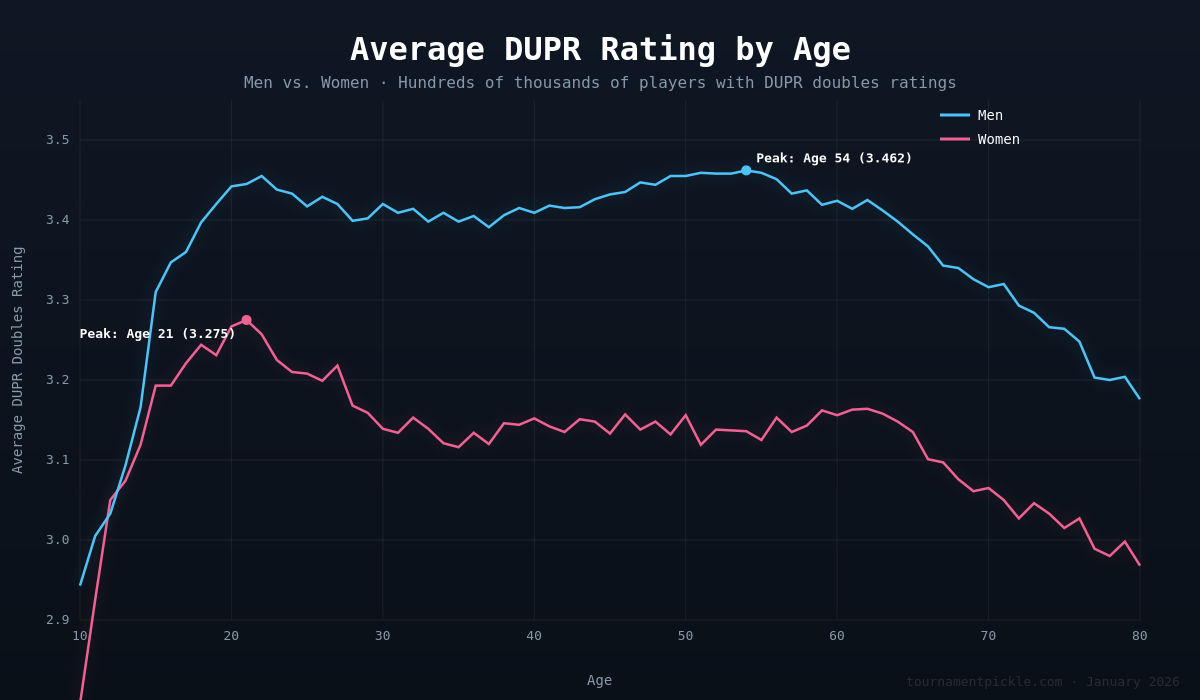
Let's get to the headliner finding: the mean DUPR doubles rating for men occurs at age 54 with a mean of 3.462.
Read that again. Not 24. Not 30. Fifty-four.
This is not a statistical quirk. The average DUPR for men stays in a ridiculously tight range (3.40 – 3.46) from their early 20s through their late 50s with not a single sign of dropping over those 35 years. The average 55 year old male pickleball player has the same rating as the average 25 year old.
🏆 Main discovery: Men’s average DUPR peak occurs at age 54 (3.462), and is remarkably stable between ages 20 and 60. The average 55 year old man is rated equally to the average 22 year old.
For women, the pattern is different but equally interesting. Women’s mean DUPR peaks earlier, around age 21 (3.275), and then plateaus. From age 25 to 65, women’s mean DUPR only wavers by about 0.08 points (3.12 to 3.20), which is remarkably consistent.
Why the different peak ages? Several factors likely contribute:
- Experience advantage: Men in their 40s and 50s likely have decades of experience in other racket sports (tennis, racquetball, table tennis) whose experience translates directly to pickleball.
- Competitive attitude: Older male players who register for DUPR and compete tend to be quite serious about their sport — they are not casual, beginner players who only play once a while in their backyards.
- Selection bias: The men who are still competing in their 50s are more dedicated than the average person at that age.
- Physical demands: The pickleball court is small and the game emphasizes skill rather than power so athleticism is not as important as experience.
Rating Breakdown by Age Group
Let's zoom out and look at how players perform across each decade of life:
| Age Group | Avg DUPR | % Rated 4.0+ | % Rated 5.0+ | Highest-Rated Player |
|---|---|---|---|---|
| 10–19 | 3.295 | 11.9% | 0.8% | 6.985 |
| 20–29 | 3.363 | 16.4% | 1.4% | 7.162 (Ben Johns) |
| 30–39 | 3.328 | 15.9% | 1.2% | 7.095 |
| 40–49 | 3.331 | 15.3% | 0.8% | 6.628 |
| 50–59 | 3.309 | 13.4% | 0.5% | 6.362 |
| 60–69 | 3.259 | 10.5% | 0.2% | 6.100 |
| 70–79 | 3.186 | 7.2% | 0.1% | 5.863 |
| 80+ | 3.090 | 4.4% | 0.1% | 5.782 |
A few things jump out from this data:
- The 20s are the “elite factory”. 20% of players in their 20s are 4.0+ (16.4%) and 1.4% are 5.0+. This age group has the most pros and semi-pros, and they dominate at the biggest tournaments in the country. Ben Johns, world #1 at 7.162, fits into this category.
- The 30s, 40s and 50s are all essentially the same. No difference in average DUPR except that values vary by only about 0.02 points across these three decades (3.31 to 3.33). You can’t tell the difference between a 35 year old and a 55 year old based on average rating alone.
- Even the 60s are remarkably consistent. At an average of 3.259, players in their 60s are only 0.1 points under the all-time average — and over 10% of ratings in this age group are 4.0 or higher.
- There are 80+ players who are still in contention. The highest rated player over 80 has a 5.782 DUPR rating, which would make the player an absolute ace at any age.
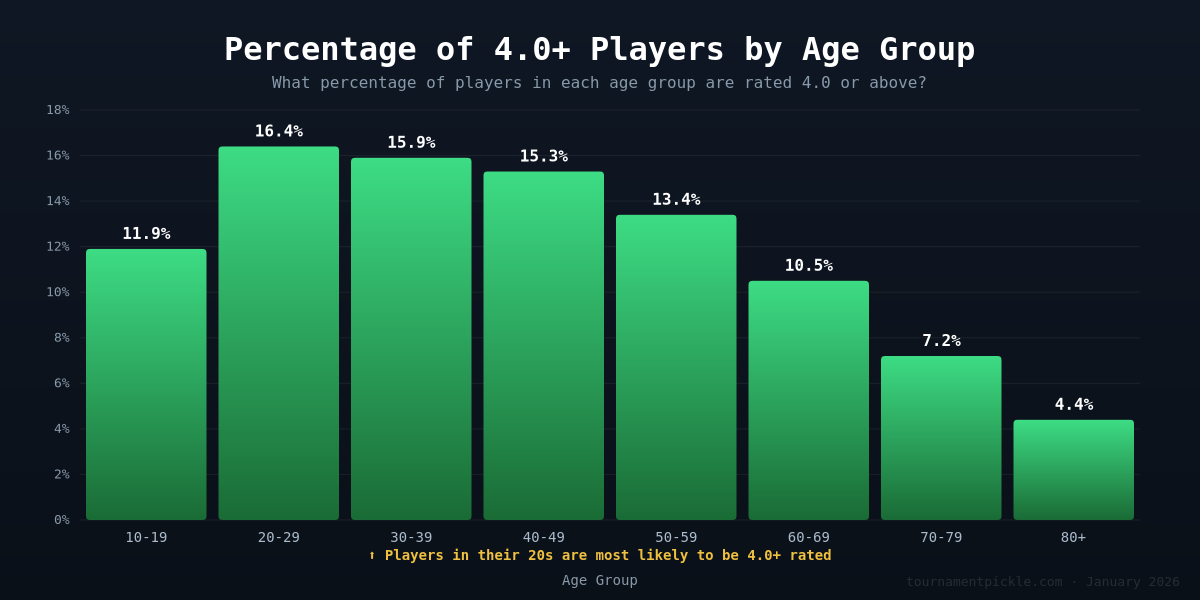
Percentage of players rated 4.0+ in each age group
Who's Playing? Pickleball's Age Distribution
Before we proceed, let’s look at who is playing. The age distribution of DUPR-rated players tells a story:
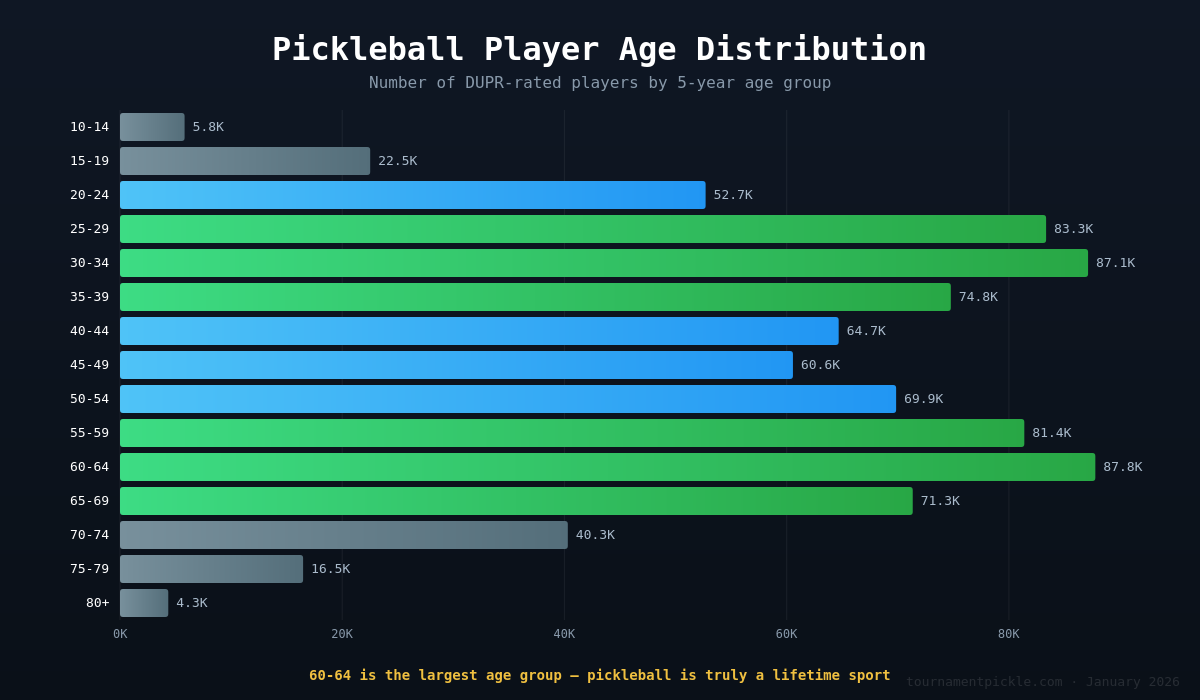
Number of DUPR-rated players by 5-year age group
What was the biggest surprise? The 60–64 age group has the most DUPR-rated players of any 5-year age group. The 30–34 age group is a close second. Pickleball really is ageless — there are tens of thousands of rated players in every 5-year age group from 20 to 75.
The distribution is bimodal — there’s one peak around age 30-40 and another around age 60-65. This makes sense because pickleball appeals to young athletic adults looking for a competitive game, but also to older adults who may have age-related issues that prevent them from participating in high impact sports like tennis.
👥 Fun fact: More DUPR-ranked players are aged 60-64 than 20-24 making it the only "major" sport where this is true.
The Incredibly Gradual Decline
The most optimistic finding from all of this data is that pickleball skills deteriorate at a very gradual pace with age.
From the combined peak around age 22 (3.369) to age 80 (3.105), the mean DUPR change is only -0.264 points. That’s a decline of less than 0.005 DUPR points per year — almost too small to track on a yearly basis.
To put this in perspective:
| Age | Avg DUPR | Decline from Peak |
|---|---|---|
| 22 (Peak) | 3.369 | — |
| 40 | 3.282 | −0.087 |
| 50 | 3.289 | −0.080 |
| 60 | 3.241 | −0.128 |
| 70 | 3.183 | −0.186 |
| 80 | 3.105 | −0.264 |
Compare it to sports like tennis or basketball where the prime playing years are brief and there is a near-total decline in performance by age 35. In pickleball, however, a 70-year-old player has an average rating that is closer to the average peak rating of all players than that of a 10-year-old player which is astonishing.
Why does pickleball age so gracefully?
- Smaller court: At 20×44 feet, the pickleball court takes up less area than a tennis court (78 feet long and width). Pace and stamina aren’t as important.
- Soft game dominance: At the top level, the “dinking” game and patience at the kitchen line are more important than power. This suits experienced players with good touch rather than pure athletes.
- Strategy compounds: Court positioning, shot selection and reading the game from your opponents all improve with experience. A player with 20 years of racket sport experience has genuine expertise.
- Lower injury barrier: The sport is less joint damaging than tennis, enabling older players to train and compete with few interruptions, as they can avoid the periods of inactivity that are necessary to recover from the heavy strain of other sports.
The Gender Gap: How It Changes with Age
Men record higher DUPR values than women in all age groups, but the margin of victory does not present itself in equal proportions. Instead, it manifests in the following ways:
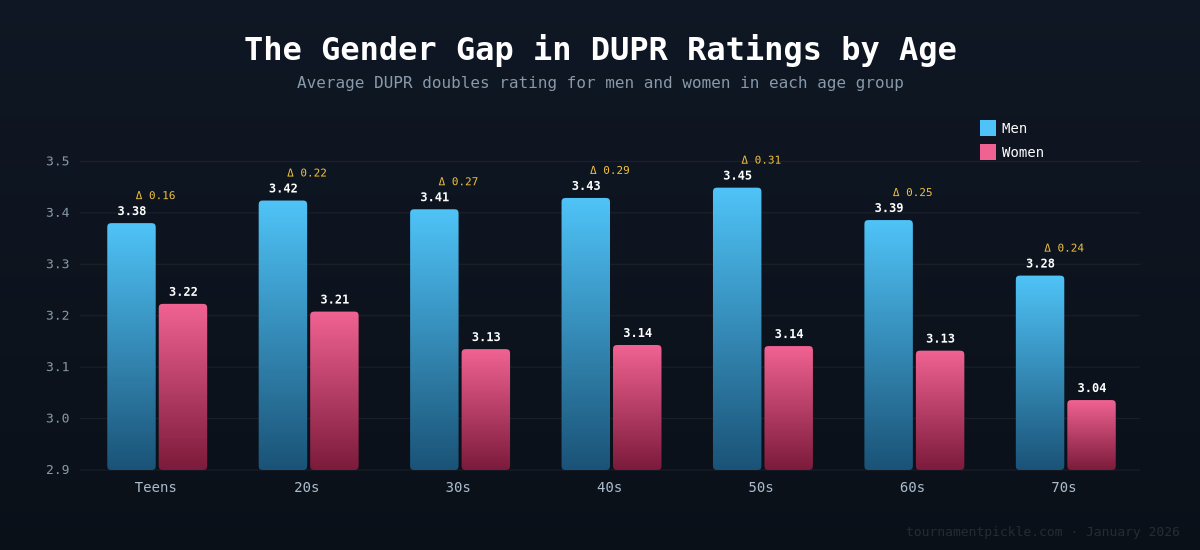
Average DUPR doubles rating for men and women in each age group
| Age Group | Men Avg | Women Avg | Gap |
|---|---|---|---|
| Teens | 3.38 | 3.22 | 0.16 |
| 20s | 3.42 | 3.21 | 0.22 |
| 30s | 3.41 | 3.13 | 0.27 |
| 40s | 3.43 | 3.14 | 0.29 |
| 50s | 3.45 | 3.14 | 0.31 |
| 60s | 3.39 | 3.13 | 0.25 |
| 70s | 3.28 | 3.04 | 0.24 |
The gap is smallest in teenagers (0.16 points) and largest in the 50s (0.31 points). This may be a result of a combination of factors including: (1) men being relatively over-represented in the more competitive age brackets, (2) differences in the level of prior athletic experience in racket sports, and (3) historical factors associated with men having more such experience in older age brackets.
One interesting takeaway: women’s average DUPR is remarkably stable from age 25 to 65, falling in the 3.13-3.16 range for decades. Men show more variability, and gradually rise and fall. Both genders show that pickleball is a sport you can remain competitive in even into your golden years.
Proof That Age Is Just a Number
The averages paint one picture, but the outliers paint another — and an even more inspiring one at that.
Consider this: the highest-rated player over 70 in our dataset clocks a 5.863 DUPR. At 72, that player would be among the highest-rated of any age. The highest-rated player over 80? A breathtaking 5.782 DUPR at age 84 — a rating that makes the player one of the absolute top 0.3% of players of all time.
There are also 70+ year old women competing at the 5.5+ level, showing that age is not a barrier to elite performance in this sport.
💪 At 84 years old, the best player in the 80+ division has a 5.782 DUPR. This level of skill would intimidate other players of any age. In what sports can an 84 year old player be an elite level competitor?
These are not outliers. 7.2% of players in the 70–79 age group have a rating of 4.0 or above - that's advanced level play. 4.4% of players in the 80+ age group have also broken the 4.0 barrier. These are experienced, dedicated players who just happen to be older.
What This Means for Your Pickleball Journey
Whether you're 18 or 80, this data has something encouraging to say:
If You're Young (Under 30)
You have the highest upside. The upside and top 1% tend to be in their 20s and 30s. If you plan on playing at the very top level, now is your prime but you also have decades of play ahead of you.
If You're in Your 30s or 40s
You are not done performing at your best level. The statistics show average performance between age 25 and 55. Keep tuning up your game and competing at a high level and you might have your best years ahead of you. Many Senior Pro players are just starting to reach their peak levels of performance around your age group.
If You're in Your 50s or 60s
You’re playing in America’s fastest-growing sport at a level that’s numerically equivalent to players who are over 20 years older than you. Senior tournaments are exploding in popularity, with thousands of tournaments held annually that have age bracket divisions. Check out senior tournaments on Tournament Pickle.
If You're 70+
You are part of the most inspirational generation in pickleball! The stats show that seniors in their 70s and 80s remain competitive with high DUPR ratings and some even achieve elite status. You are making pickleball a sport for a lifetime!
Finding the Right Competition for Your Age
The competitive pickleball scene is awesome because of the age brackets that they have. Most tournaments are by age bracket (19+, 35+, 50+, 60+, 70+, etc) and skill level (DUPR rating), so you play against people your age!
This means you don’t have to fight against 25 year old players at 65 (unless you want to) as most senior players do play open divisions and thrive (as shown by stats).
🏓 Find Tournaments by Age Bracket
Explore numerous upcoming pickleball tournaments. Select tournaments based on location and date and skill level.
Search Tournaments🔍 Look Up Any Player's DUPR Rating
You can check your ranking, compare your results with friends, or see how you perform against other players.
Search Players📋 Methodology
This analysis is based on hundreds of thousands of players with DUPR doubles ratings and recorded ages as of January 2026. Average DUPR ratings are calculated for each integer age and grouped into decades for summary statistics. Half-year ages (e.g., 17.5) were rounded down to the nearest integer. Gender analysis includes only players with recorded gender (M or F). Players without a recorded age or DUPR doubles rating were excluded. Age data reflects player-reported information. DUPR is a registered trademark of DUPR LLC. For more about DUPR ratings, see our DUPR Rating Explained guide or visit dupr.com.