Singles vs. Doubles Pickleball Tournaments: Which Should You Enter?
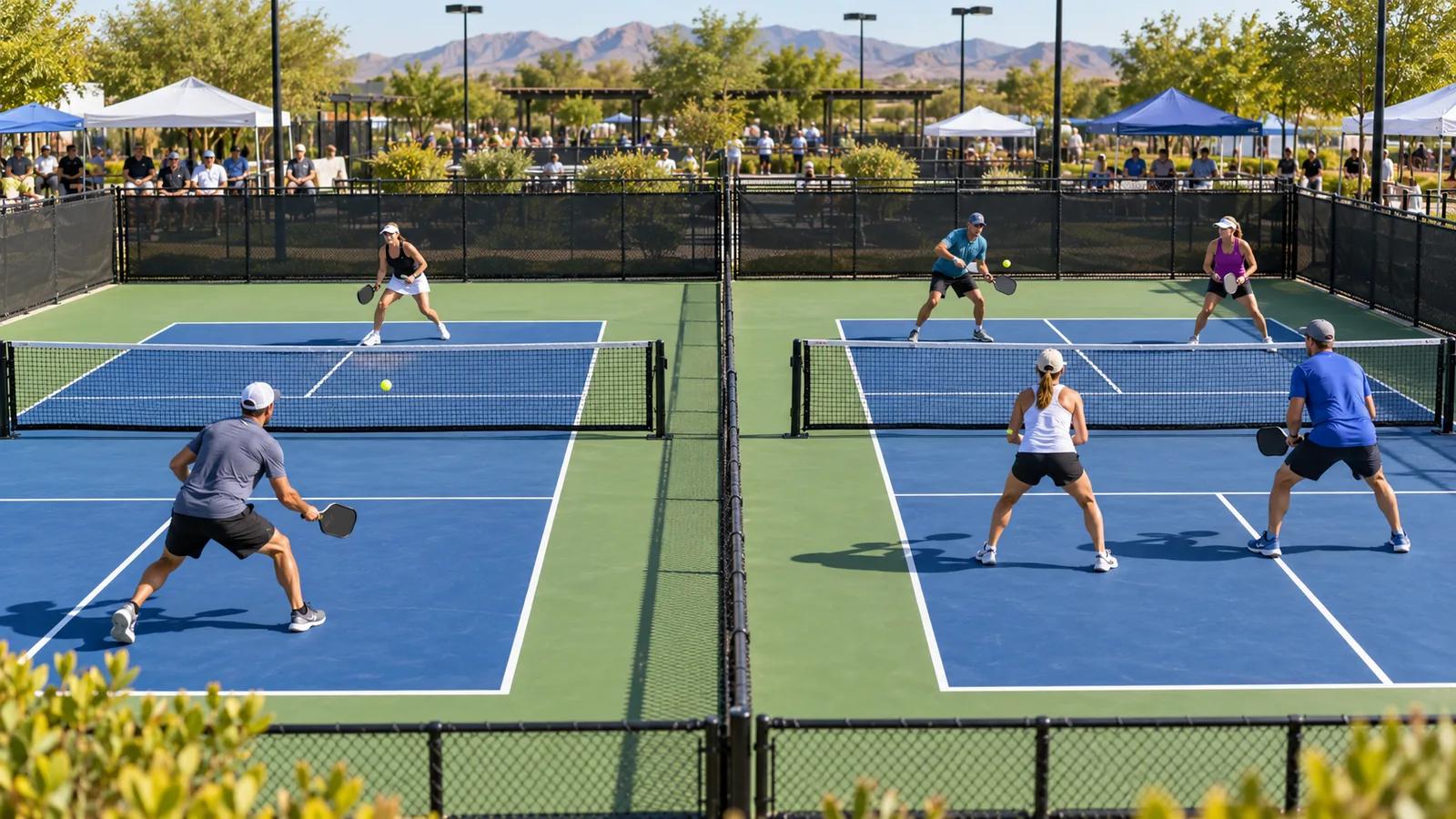
Enter doubles if you want the widest choice of divisions, prefer sharing court coverage, or already have a partner whose style fits yours. Enter singles if you want every tactical decision in your hands and are comfortable covering the full court alone. For many first-time competitors, doubles is the easier place to start. If both formats appeal to you, the best test is to play each locally before paying for both at one tournament.
The choice is not just a matter of preference. Singles and doubles can have different ratings, schedules, division availability, and registration requirements. Tournament Pickle’s current event index also shows that doubles is much easier to find, even though hundreds of upcoming listings offer both.
Singles vs. doubles at a glance
| Question | Singles | Doubles |
|---|---|---|
| Who should enter? | Players who like open-court movement, one-on-one patterns, and full control of decisions | Players who like coordinated positioning, partner communication, and shared problem-solving |
| Partner required? | No | Usually yes; some events offer partner matching or scramble formats, but never assume it |
| Court coverage | One player covers the same 20-by-44-foot court | Two partners cover their end of the court |
| Rating to check | Your singles rating and the organizer’s singles bracket rule | The applicable doubles rating and the organizer’s team-rating rule |
| Current availability | 466 of 992 indexed current/future listings | 869 of 992 indexed current/future listings |
What Tournament Pickle’s event data shows
We analyzed Tournament Pickle’s tournament and event collections on October 27, 2026 at 9:00 a.m. Pacific. The tournament filter kept listings whose end date had not passed and excluded records marked canceled or marked as having questionable dates. That produced 992 current or future tournament listings.
- 869 listings offered standard doubles in their stored format data.
- 466 offered standard singles.
- 449 offered both, so players did not necessarily have to choose one format for the whole tournament.
- 420 offered doubles but not singles, while only 17 offered singles but not doubles.
- 106 were not classified as either standard format; 103 of those had no format data at all.
The division-level records tell the same broad story. After excluding canceled event records and UTR draw objects, the active listings contained 22,051 standard-doubles division records and 7,408 standard-singles division records. We kept 426 skinny-singles, 36 doubles-scramble, and two blind-draw records outside that standard comparison because they are meaningfully different products.
Coverage limitation: these are indexed listings and division records, not unique players, registrations, or completed matches. The 992-listing sample comprised 932 Pickleball.com/PickleballTournaments.com records, 49 Pickleball Den records, and 11 UTR records. Some organizers are absent, format fields can be missing, and future brackets can change. The analysis supports a conclusion about availability in Tournament Pickle’s current index; it does not prove that players prefer doubles by the same ratio.
To see what is actually available where you live, search the upcoming pickleball tournament calendar and open each event’s division list rather than relying on the tournament name alone.
The physical and tactical difference
The 2026 USA Pickleball Official Rulebook sets the court at 20 feet wide by 44 feet long for both singles and doubles. In singles, one player is responsible for that end of the court. In doubles, two partners share it. That simple fact changes which shots are valuable and which mistakes get exposed.
Singles rewards space management
Singles gives you more open court to attack, but the opponent has the same opportunity. A deep return, a serve that creates a short reply, and a controlled approach often matter more than trying to reproduce a patient four-player kitchen exchange. Recovery position matters after every shot because there is no partner protecting the open side.
Before entering, play several full games under tournament conditions. If your shot quality collapses after repeated wide movements, or if you cannot recover after serving and returning, a singles bracket will reveal it quickly. That is useful feedback, but it is better to learn it before the entry fee and travel day.
Doubles rewards coordination
Doubles removes some individual court-coverage burden but adds partnership decisions. Who takes the middle ball? Will you stack? Which player receives on each side? What happens when one opponent repeatedly targets the same partner? A technically solid team can still leak points through hesitation or conflicting movement.
Do not choose a partner solely because your ratings are close. Play together first and talk through middle-ball responsibility, returns, third shots, time-outs, and how you will handle a rough stretch. Compatibility is not the same as friendship, and tournament pressure makes vague assumptions expensive.
Use the rating for the format you are entering
DUPR’s current explanation says players receive separate ratings for singles, gender doubles, and mixed doubles. Its own singles-versus-doubles ranking guide explains why performance can differ between formats. Do not assume a strong doubles number automatically places you correctly in singles, or vice versa.
The organizer’s rule still controls entry. A doubles division may use the higher partner’s rating, an average, a combined cap, or a rating as of a specified date. Read the listing, then compare it with the practical examples in our guide to DUPR ratings for pickleball tournaments. If the language is unclear, ask the tournament director before registering rather than choosing the bracket you hope applies.
Registration and scheduling traps
For doubles, solve the partner question first
Some registration systems let you register while your partner is pending. That does not always reserve a complete team slot. Check whether both players must register and pay by a deadline, whether unmatched players move to a waitlist, and whether the organizer offers a partner finder.
Do not count on a late substitution. Under Rule 18.G of the 2026 USA Pickleball rulebook, a tournament director may approve a doubles partner change before the first-round match for injury, illness, or circumstances beyond the player’s control; a change after team play starts is prohibited. Independent events can publish their own procedures, so read the refund and substitution policy as well.
If you enter both, inspect the calendar
Singles and doubles may be scheduled on separate days, but the listing should confirm it. Look at check-in times, possible bracket duration, travel, recovery, and whether mixed and gender doubles overlap. The official rulebook does not permit a player to enter events with overlapping time windows on the same day. Even without a formal overlap, a long singles day can affect how you feel in doubles the next morning.
A practical decision checklist
- Choose singles if you enjoy one-on-one patterns, trust your movement over a full game, want no partner dependency, and have a usable singles rating or an organizer-approved placement.
- Choose doubles if you want more event choices, have a tested partner, communicate well, and prefer coordinated point construction.
- Choose both if they occur on separate days, the added fee fits your budget, and you have prepared for the combined workload.
- Wait before registering if your partner is unconfirmed, the bracket rule is ambiguous, or the listing does not explain schedule and refund terms.
For a broader preparation list covering registration, equipment, check-in, and match day, use our first pickleball tournament guide. The format decision should make the rest of the day simpler, not create a problem you discover at the desk.
Frequently asked questions
Is singles or doubles better for a first pickleball tournament?
Doubles is usually the more accessible first choice because there are more available divisions and court coverage is shared. Singles can still be the right debut if you already play it regularly and are comfortable with its movement demands.
Can I enter both singles and doubles at the same tournament?
Often, yes. Confirm that the events do not overlap, budget for separate event fees, and account for recovery. USA Pickleball rules do not permit entry in events with overlapping time windows on the same day.
Do singles and doubles use the same DUPR rating?
No. DUPR currently reports separate ratings for singles, gender doubles, and mixed doubles. Use the rating and eligibility method named by the organizer for the division you are entering.
Do I need a partner before registering for doubles?
It depends on the event. Some allow a pending partner or provide matching tools, while others require both players to register by a deadline. Verify when a team slot becomes secure and what happens if a partner withdraws.