Sanctioned vs. Unsanctioned Pickleball Tournaments: What Changes?
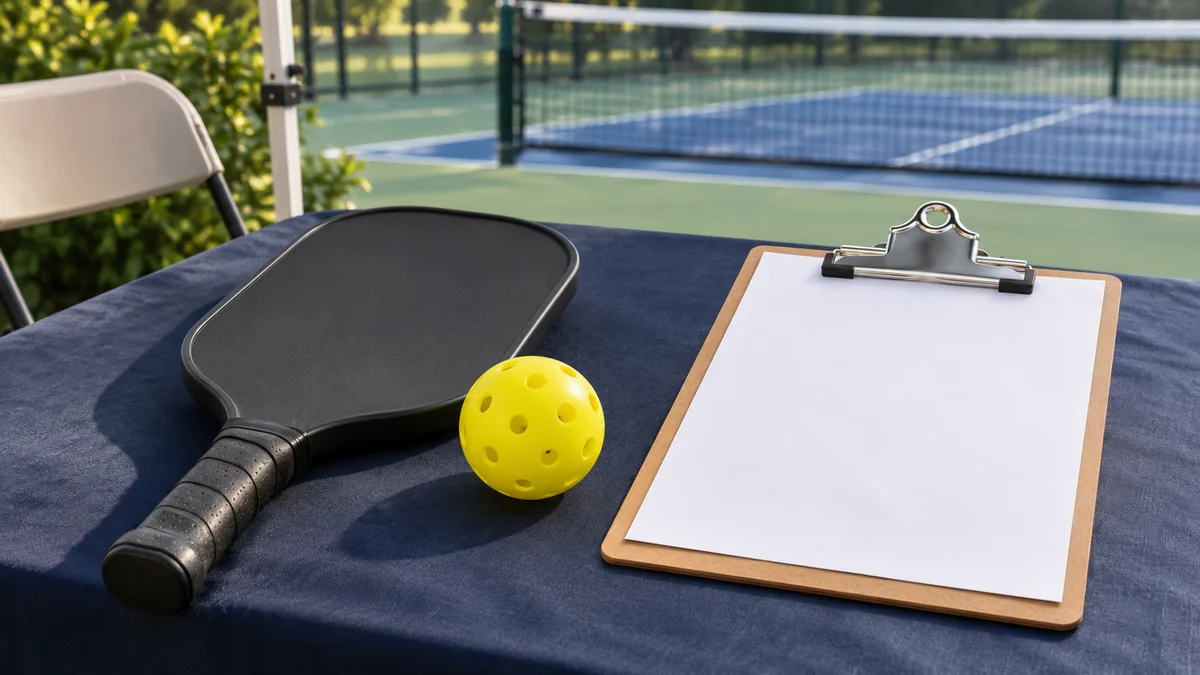
A sanctioned pickleball tournament has been approved under a sanctioning body's requirements; an unsanctioned tournament has not received that body's approval. For USA Pickleball events, the practical differences include membership eligibility, approved rules and equipment, referee arrangements, and results reporting. The label alone does not tell you how strong the field is, how many matches you will play, or whether your results will reach DUPR.
This guide compares USA Pickleball-sanctioned events with events outside that program. If an organizer names a different sanctioning body, check that body's requirements instead. Official-source guidance and Tournament Pickle's separate catalog analysis below were checked on November 17, 2026.
What sanctioning actually tells you
USA Pickleball's sanctioning guidance describes an approval process with standardized requirements. Organizers must follow its rulebook and approved formats. Approved tournaments receive recognition and a place on its sanctioned-event calendar.
Unsanctioned does not mean rule-free. The introduction to the 2026 Official Rulebook explicitly says non-sanctioned tournaments may use its rules as guidelines, with flexibility for their players. An independent organizer might adopt the same playing rules while making different choices about scoring, registration, or officiating.
Treat sanctioning as an administrative distinction, not a shortcut for judging the entire experience. Before paying, compare the actual division, schedule, match format, and cancellation policy. A sanctioning label cannot answer those questions for you.
Membership: check eligibility before paying entry fees
USA Pickleball currently requires an active Challenger or Champion membership for sanctioned tournament participation. Its membership page confirms that both levels include eligibility for sanctioned events, Golden Ticket tournaments, and Nationals. Eligibility is not a reservation: you still need to meet the event's entry requirements and obtain a place in the draw.
As checked on November 17, 2026, USA Pickleball lists Challenger membership at $12 per year. That is a membership price, not the tournament's entry fee or a guarantee of admission. Check the current membership page before buying, especially if you are reading this in a later season.
For an event outside USA Pickleball sanctioning, read its own membership and account requirements. Do not assume that “unsanctioned” means no club membership, platform account, or additional charge. Ask whether both doubles partners must complete a membership check and whether membership must remain active through the event date.
Referees: sanctioned does not mean every match has one
USA Pickleball names three sanctioning options: Standard, Medal Match Plus (MMP), and No-Referee. Their existence matters more to a player than a vague promise of an “official” tournament. A sanctioned event can have a No-Referee designation.
Ask which option applies and what officiating is planned for your division. Will your pool matches be self-officiated? Who handles a rules dispute? Where do you find the tournament director or head referee? Get those answers from the event, rather than assuming that the tournament's branding promises an official beside every court.
Also separate officiating from bracket format. Round robin and double elimination describe how competition progresses; they do not, by themselves, tell you who calls faults or keeps score. Our tournament-format guide explains those bracket choices. Use the organizer's published format to decide whether the amount of play suits your trip.
Equipment: verify the exact paddle, not just the brand
Rule 18.A of the 2026 USA Pickleball Official Rulebook requires an approved paddle that complies with its specifications. It makes players responsible for confirming that their paddle appears on the USA Pickleball Approved Paddle List. Check your exact model against the current list through the official rules and equipment resources.
The timing of a problem matters. Under Rule 18.A.1, a non-compliant paddle discovered before a match starts must be replaced, with no penalty for switching. Under Rule 18.A.2, discovery during play results in a match forfeit. A compliance check before leaving home is much easier than dealing with that on court.
For an unsanctioned event, ask which equipment policy applies. Its organizer may adopt USA Pickleball requirements, so the absence of sanctioning is not permission to use any paddle. Bring a compliant backup if you have one, and confirm the event's ball and equipment instructions before your playing day.
Ratings and results reporting are separate questions
Do not translate “USA Pickleball-sanctioned” into “automatically reports to DUPR.” USA Pickleball's current sanctioning FAQ allows organizers to use either DUPR or UTR-P as a rating system. Ask which rating determines bracket eligibility and which system receives results; those are related but different decisions.
DUPR's own guidance on tournament results emphasizes checking the listing, asking the director, and checking your match history afterward. Using a DUPR number to place players is not proof that results will be submitted. Get an explicit reporting commitment rather than inferring one from registration software or a logo.
USA Pickleball also has its Tiered Point System (TPS). Its current guidance says all USA Pickleball-sanctioned tournaments participate, with results submitted through its system for verification using approved software. TPS helps determine Nationals registration eligibility; it is not your DUPR skill rating and does not itself promise a place in a full bracket.
If Nationals is your goal, verify the qualification cycle, event tier, and current registration rules directly. Do not book travel using a previous season's points threshold or assume that every sanctioned tournament is a Golden Ticket event.
Our catalog check: missing labels are not “unsanctioned”
First-party Tournament Pickle analysis: on November 17, 2026, we audited 865 stored tournament records with start dates from November 17, 2026 through November 16, 2027, using UTC date boundaries. We excluded records marked canceled, records with questionable dates, and records carrying an explicit source cancellation flag.
None had a normalized, top-level sanctioning field. Within the stored Pickleball Den source data, 10 records carried a “USA Pickleball” label. That label was extracted from image text, not independently verified against the governing body's event calendar. Other source data included empty badges and a club-level sanctioning flag, neither of which establishes an individual tournament's status.
We therefore did not calculate a percentage of sanctioned or unsanctioned tournaments. These are catalog records, not a deduplicated census of real-world events; source freshness varies, and the audit did not independently verify every event. Missing information remains unknown. The useful finding is a search limitation, not a claim about how common sanctioning is.
Start with Tournament Pickle's tournament search to find practical options, then cross-check the organizer's registration page and USA Pickleball's tournament calendar. If the status is unclear or the two disagree, ask for confirmation before spending money that depends on it.
A short checklist for choosing between two events
Compare the terms that affect your weekend, not just the badge:
- Purpose: Are you seeking Nationals eligibility, reported rating results, or simply a suitable competitive day? Verify the requirement that serves that goal.
- Eligibility: Check membership, age, skill, partner status, and whether registration is confirmed rather than waitlisted.
- Play: Confirm the bracket format, scoring, expected schedule, and officiating arrangements for your division.
- Total cost: Add entry, division, membership, and travel costs. Read the withdrawal and weather policies before comparing value.
- Afterward: Know who submits results, to which system, and how to report a missing or incorrect score.
If sanctioning is essential to your goal, establish it first. If it is not, choose on the verified event details. Neither label substitutes for a clear registration page and an organizer who can answer specific questions.
Frequently asked questions
Do all sanctioned pickleball tournaments have referees?
No. USA Pickleball offers Standard, Medal Match Plus, and No-Referee sanctioning options. Confirm the event's option and the officiating planned for your division.
Do I need a USA Pickleball membership to enter a sanctioned event?
For USA Pickleball-sanctioned events, you need an active Challenger or Champion membership. Membership eligibility does not guarantee a place in a tournament.
Does sanctioning guarantee that my results go to DUPR?
No. USA Pickleball allows organizers to use DUPR or UTR-P. Ask the organizer which rating system receives results and check your match history afterward.
Does a missing sanctioning label mean an event is unsanctioned?
No. A missing catalog label means the status is unknown. Verify it with the named sanctioning body's event calendar and the tournament organizer.