Pickleball Camps vs. Clinics vs. Tournaments: Which Is Right for You?
Choose a pickleball clinic to work on a specific problem, a camp for a sustained block of coaching, and a tournament to test your game against opponents. The best choice depends on what you want to do differently afterward, not which option sounds more serious. A tournament can reveal a weakness without teaching you how to fix it; a camp can teach a better pattern without showing whether you can use it under pressure.
Start with that distinction before comparing destinations or prices. Then look past the label. A camp might be a concentrated training program or a vacation with some instruction. A clinic might introduce the basics or focus tightly on one advanced skill. The actual schedule is more useful than the name.
Camps, clinics, and tournaments: what you are buying
A clinic: focused instruction
For this guide, a clinic means a relatively focused coaching session rather than an extended training trip. It is a sensible choice when you can name your problem: returns landing short, uncertainty about when to move forward, or difficulty controlling a volley. Ask whether the session teaches that problem specifically and whether the coach will watch you attempt the solution.
A demonstration is not the same thing as feedback. Look for opportunities to try a shot, receive a correction, and try again. If the description simply says “all skills,” ask how the instructor will accommodate players with different needs.
A camp: connected training time
A camp is useful when you want several parts of your game assessed together. Technique, positioning, shot selection, and partner movement can be taught as a connected sequence instead of isolated tips. A multi-day schedule also gives you another session in which to revisit a correction.
These are practical distinctions, not universal industry definitions. On its official training-camp page, Engage advertises two-day camps and an 8:1 ratio. US Sports Camps describes several program formats and explicitly says details vary by location and sport. Check the individual program before assuming that a familiar brand or label guarantees a particular experience.
A tournament: competitive feedback
A tournament is the better fit when your main question is, “Can I execute against unfamiliar opponents when the result matters?” You are buying entry into a competition, not individualized coaching. You might learn that your return breaks down, your partner communication is vague, or your reliable practice shot disappears when rushed. Diagnosing the cause may require work afterward.
Before entering, check the bracket, scoring, eligibility, and expected match opportunities. Our tournament-format guide explains those trade-offs. For official playing rules, use the USA Pickleball rulebook hub alongside the organizer's published conditions.
What our camp catalog can—and cannot—tell you
We analyzed Tournament Pickle's camp catalog on November 10, 2026. To avoid presenting old listings as current options, we selected records scheduled to start from November 10, 2026 through February 9, 2027, with a recorded verification timestamp on or after October 11, 2026. We excluded deleted, canceled, and completed records, as well as records tagged with our manual source.
That left 39 records. We collapsed records sharing the same registration URL and start date, retaining the most recently verified version, to produce a 35-listing comparison sample. The date window uses Pacific-midnight boundaries. This grouping reduces obvious duplicates; it is not a guarantee that every listing represents a different underlying program.
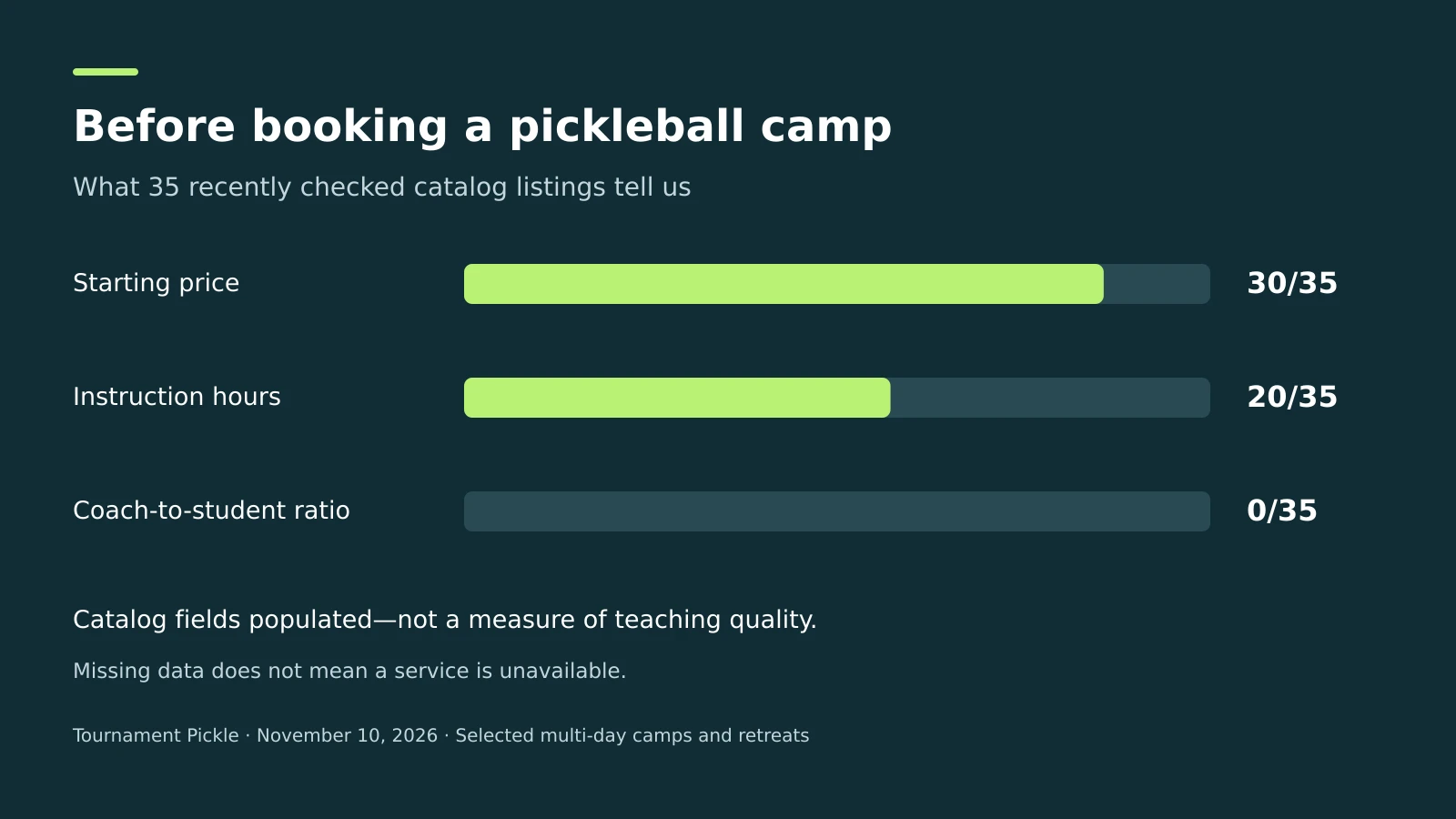
- 30 of 35 had a positive starting-price value in the catalog.
- 20 of 35 had a positive instruction-hours value.
- None of the 35 had a populated coach-to-student-ratio field.
The useful finding is about comparison quality, not which provider is best. A price is easier to compare than what that price buys. Missing instruction hours do not mean there is no instruction. Likewise, our empty ratio fields do not mean providers fail to disclose ratios: Engage's official page is a direct counterexample.
Coverage limits: the filtered sample contains multi-day camps and retreats, not a representative set of local clinics. Sold-out listings remain included because this is a study of information coverage, not available seats. Verification timestamps indicate catalog processing, not a personal confirmation with every organizer. We cannot use these fields to rank teaching quality, calculate a trustworthy market-wide hourly price, or promise improvement.
Match the choice to your current bottleneck
You know the weakness but cannot fix it
Choose targeted instruction first. For example, if your reset consistently pops up, look for a clinic that includes that situation rather than another broad overview. Ask whether the instructor can evaluate your contact point and decision-making during live repetitions. Leave with a practice task you can repeat locally.
Your game feels disconnected
A camp may be the better fit if you can perform shots separately but struggle to build a point. Ask how the curriculum connects serving, returning, transition play, and the kitchen exchange. You want coached decisions, not just a long list of strokes. Confirm how players are grouped and what happens if the advertised group is too easy or too demanding.
You want an honest competitive benchmark
Choose an appropriately placed tournament if you already play full games comfortably and want to see how your skills hold up. Decide beforehand what you will observe beyond the score: return depth, avoidable misses, communication, or response to an opponent's adjustment. Record patterns afterward rather than rebuilding your technique between matches.
Compare coaching value without inventing an hourly bargain
Start by separating coached court time from open play, demonstrations, breaks, meals, and travel. Each may be enjoyable, but they are not interchangeable. Dividing a package price by the entire trip length can make a retreat look like inexpensive instruction when much of the package pays for something else.
Ask for the total price you would actually pay, including mandatory fees and any required lodging. Then establish which meals, court access, and instruction are included. Only compare cost per coached hour when both programs define those hours clearly and the price components are reasonably comparable.
Group size needs similar care. A published ratio is a useful starting point, but ask how it works on court: Are coaches circulating? Is everyone hitting or waiting? Are sessions split by ability? A famous instructor appearing briefly is a different offer from that instructor coaching your group throughout the program.
For tournaments, compare the full trip cost with the format and expected play—not with camp instruction hours. Neither a cheap entry fee nor an expensive training package establishes value by itself.
Before you book: a short verification checklist
- Fit: What ability level and age group is the program designed for, and how is placement decided?
- Delivery: Who teaches, how much time is coached, and how are groups organized?
- Conditions: What surface and indoor or outdoor setting will you use, and what is the weather backup?
- Commitment: What is refundable, transferable, or lost if you cancel? What happens if the organizer cancels?
- Availability: Is your place confirmed, or are you joining a waitlist?
Use the Tournament Pickle camp directory to build a shortlist, then confirm the details on the provider's registration page. If competition is your priority, compare dates and locations in the tournament calendar. A directory helps you discover options; the organizer must confirm what you are booking.
Frequently asked questions
What is the difference between a pickleball camp and a clinic?
A clinic generally focuses on a shorter session or narrower skill goal, while a camp offers a more sustained training block. Providers use the labels differently, so compare the actual curriculum, coached hours, and group structure.
Should I take a camp before my first tournament?
Not automatically. Choose coaching first if you need help with fundamentals or a specific recurring problem. Choose a suitable tournament if you can already play complete games and want competitive experience. Check the organizer's entry requirements either way.
Does a multi-day pickleball camp include lodging?
Do not assume it does. Ask whether the price includes accommodation, meals, and transport, or only instruction and court time. A multi-day schedule describes duration, not necessarily a lodging package.
Are missing camp details a reason not to book?
They are a reason to ask the provider, not proof of a poor program. Our catalog sample had much better price coverage than instruction-hour or coach-ratio coverage. Resolve the details that matter to you before paying.